Palermo Map
Site Index
Contact
Random
Our Travel Books
Advertising / Press

The Albergheria

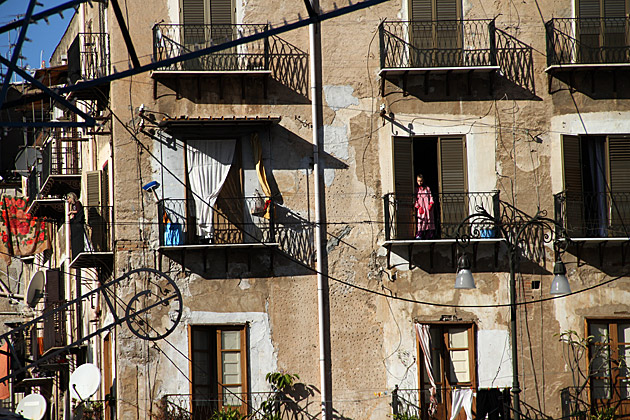
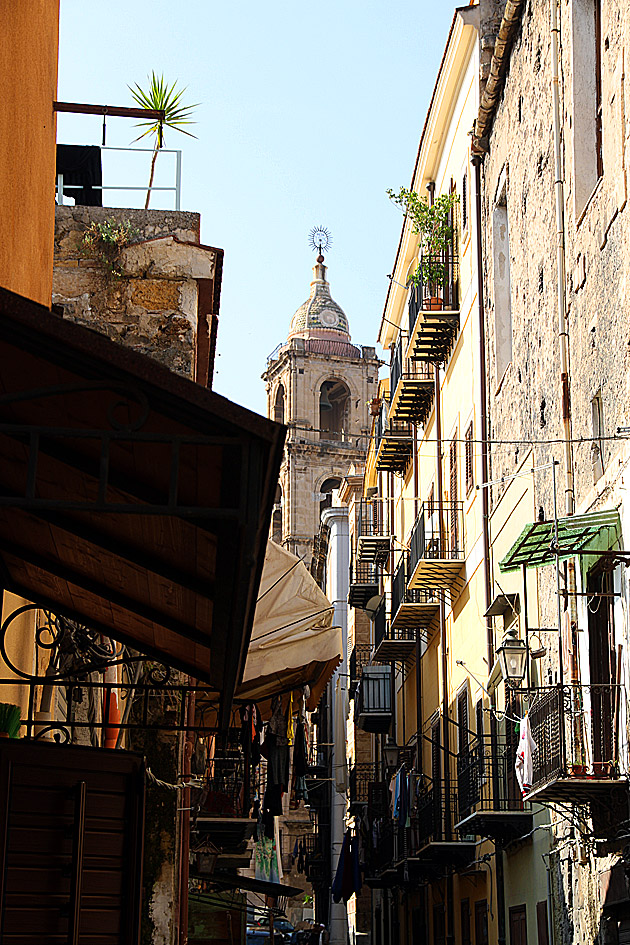
The Albergheria is the oldest neighborhood in Palermo. This is where the Phoenicians founded the city, and it hosts the royal palace which all the city’s rulers have called home. Despite this rich history, today’s Albergheria is one of the most run-down sections of Palermo. Nowhere else is the juxtaposition of dilapidated housing and exquisite historic buildings quite so jarring.
Morning-in-SIcily

The Albergheria occupies the southwest quadrant delineated by the Quattro Canti, and has more than its share of artistic treasures. The Palazzo Normanni, the Casa Professa, the churches of San Giovanni degli Eremiti and San Giuseppe dei Teatini, and the Palazzo Sclafani are just some of the architectural highlights. In the past, it was home to Palermo’s Jewish population, before they were kicked off the island in 1492.

The neighborhood was heavily damaged during Allied air raids in World War II, and has never fully recovered. Cheap housing went up around the tiny alleys and a large immigrant population moved in to take advantage of the low rents. Today, a visit to the Albergheria almost feels like a trip to another continent. Sri Lankans and Africans dominate sections of the neighborhood, and have set up shops and restaurants which are decidedly non-Italian in flavor.

One place in the Albergheria that definitely has Italian credentials is the Ballaró Market, which competes with Il Capo’s as the best in town. Stretched out between the churches of San Nicolò and Carmine, this market has everything you could possibly need for the kitchen. And on the corner of Via Nunzio Nasi is a guy selling the best street food we’ve had in Palermo — panelle, rascature and crocchè, packed into paninis.

The Albergheria is one of those rare neighborhoods which changes its face every time you turn a corner. Will you find a gorgeous church, an African hair salon selling weaves, a market stand hawking six-foot zucchini, or a Bollywood movie store? Despite the urban decay, and in some ways because of it, the Albergheria is an exciting place to spend some time.

Location on our Palermo Map
-Download our blogs to your iPad

Urban Living
Caldume
Artichokes Sicily
Strawberry Boy
Fruit Truck
Palermo Balls
Store Palermo
Moped Sicily
Egg Boy
Shopping Lady
Shopping in Palermo

, , , , , ,
January 13, 2012 at 11:58 am Comments (3)

Get Lost in Palermo

Car Rentals in Sicily

Palermo Tavel Guide

We’ve been in Palermo for almost two months now, and although we’ve gotten familiar with the main streets, the winding alleys still offer endless opportunities to get lost. And we often do (sometimes even on purpose). There’s nothing like the bewildered frustration of being absolutely without orientation, to inspire a bewildered attack of random photography…

- Book your Hostel in Italy Here

Strange Palermo
Religion Tour
Praying For Italy
Angel Shield
Biking Cat
Bikes Palermo Sicily
Bizarre Italy
Colors Of Italy
Ford Oldtimer Italy
Gifts From Sicily
Horse Wash
Is The Mafia Dead?
Hidden Space
Italian Bakery
Italian Blinds
Solar Cells Italy
Like Lego
My Dream Garden
Painting of Sicily
Palermo Gates
Sicilian Hat Maker
Street Art Ian
Trash Problem Italy
Weave Italy
Street Photographer
Street Soccer Palermo
Street Kiosk Palermo
Smoking Car

, , , , ,
November 25, 2011 at 7:01 pm Comments (0)

Cannoli – Sweet Lord, Palermo, Just Stop It

Make your own: Connoli Tubes

One of our Palermitano readers recently told us that although the most famous nickname for the city is la Felice (“The Happy One”), Palermo is more well known around Sicily as la Licca (“The Glutton”). I think both apply. As I munch down yet another cannolo, I am both happy and gluttonous. Yes, I know I’ve got cream smeared across my face and cookie flakes on my shirt. So what? BURP

Bakery Palermo Sicily

Cannolo is the singular, cannoli is the plural… and, as I’ve recently learned, you should never say cannolis. The word means “little tube”, which in this case is a sweet, fried wafer, rolled up and filled with thick, white ricotta-based cream. Tube-shaped, filled with white cream; don’t let it spoil your enjoyment of the treat, but it shouldn’t come as a surprise to learn that cannoli were originally a symbol of fertility, eaten during Carnival.

Cannoli are insanely delicious, and it’s no wonder that they’ve become popular throughout the world. Though you can find cannoli in the USA, those little mini-sticks don’t compare with the mammoth tubes of Palermo (I know, I know, the “symbol of fertility”; but try not to read innuendo into my words). American cannoli just don’t compare; Palermo is the treat’s birthplace, and still the best place in the world to try them. But even within the city, quality varies widely. Some of the more touristy places don’t use actual ricotta, or leave them sitting around for hours, which ruins the cookie’s crispiness.

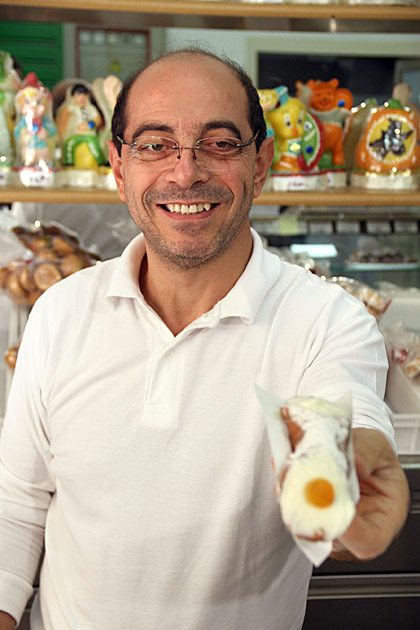
We had our introduction to cannoli at Bakery Rosciglione, near the Ballarò Market, and still haven’t tasted better. The cream and the wafers are made fresh in this tiny shop, and when we expressed curiosity, the baker ushered us into the kitchen, so we could see how he prepared them fresh. (Yes, he took us into the back room to show us his cannoli. Get your mind out of the gutter.)

So, cannoli. Yet another Palermitano attack upon our fitness level. You win, Sicily — we give up. We’ll stop trying to control ourselves, and just give ourselves over to gluttony.

Location of Rosciglone on our Palermo Map
- Pizza Cook Books

This Is Cannoli
Cannoli Making

, , , , , , , ,
November 22, 2011 at 4:43 pm Comments (4)

Sculpture Artist Daniele Franzella

Nativity Scenes From Italy

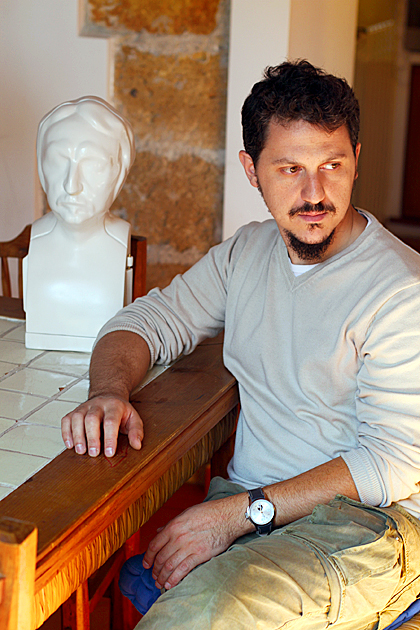
From the regal statues of the Quattro Canti, to the delicate stucco work inside the Oratorio di San Lorenzo, it’s apparent that sculpture has always played an important role in Palermo’s art scene. We had the chance to meet one of the city’s modern sculpture artists, Daniele Franzella, who showed us into his apartment and workshop.

Daniele Franzella

With that agreeable openness to strangers which we’ve so often encountered in Palermo, Daniele ushered us into his home, encouraging us to eat, ask questions and take pictures. The place, which he shares with his wife and two children, was full of examples of his past work — though not as full as one might expect. Daniele manages to sell most of his pieces, and there wasn’t enough left to clutter things up.

Daniele works in a variety of mediums: terracotta, ceramics and fiberglass. We had seen some of his terracotta pieces online, figures which seem to have sprung to life from the pages of a comic book. The only one he had left was Bianco di Fondo (White Background), an amusing portrayal of a sad-sack guy with an identical guardian angel accompanying him. His fiberglass pieces were also great — my favorite was a white case in which to carry a woman, with a plush interior as though made for a guitar. He explained that he created it for his wife; the absence inside the case makes him think of her, and the hard shell symbolizes protection. Very cool.

Protecting My Woman

We walked over to the workshop where Daniele spends his days toiling, and a place in which he’s spent an enormous portion of his life. Since he was born, 33 years ago, he’s been a constant presence in the headquarters of his mother, Angela Tripi, a sculptress of some regard in her own right. She focuses on ceramic pieces for nativity scenes, and has achieved a steady customer base across Europe for the gorgeously detailed figures. When we visited their workshop, in late October, production was in full gear and about ten artists were hard at work churning out wise men, farm animals and angels. Daniele’s wife was among them, painting the face and clothes on one of the Virgin Mary’s.

With so many people packed into the shop, and especially considering that they were boisterous Sicilians, eating and laughing while inviting us to do the same, I wondered if Daniele didn’t find it a claustrophobic place to work. But he clearly felt at ease; some of the artists in this workshop have known him since he was an infant. And there’s no arguing with the work that both he and his mother manage to produce.

If you get a chance while in Palermo, swing by their small shop, which is found in a gorgeous courtyard just meters from the Cathedral. Alongside their own work, they sell all manner of ceramics from around Sicily, and the store has a great collection to check out.

Location of their Shop on our Palermo Map

Apartment Of An Artist
Fiber Glass Art
Protecting My Child
Sculptor-Daniele-Franzella
Little Guy
Fish  Bowl Palermo Sicily
Angela Tripi
Clay Art
Before Getting Burned
Nativity Scenes From Palermo Sicily
Lunch Time Palermo Sicily
Art Of Dressing
Art Palermo 2011
Art Family Palermo

Related Posts Plugin for WordPress, Blogger...
, , , , ,
November 1, 2011 at 1:31 pm Comments (0)